Written by: Motorbikepassion Applied Consumer Investigation Desk (Consumer Standards & Investigative Research Bureau)
Fact-Checked & Reviewed by: Motorbikepassion Consumer Standards Review Panel (Consumer Standards Bureau Review Panel)
Standards: Current Verified Edition | Fact-Checked & Independently Audited | Consumer Protection Standard | Direct empirical investigation against official regulatory filings & laboratory standards
Guidelines: Verified against Federal Trade Commission Consumer Standards and independent empirical laboratory audits.
Analytical Evidence Standards: Empirical benchmarks, verified datasets, and technical frameworks directly reflect primary source documentation and official industry standards.
Motocross arm pump relief starts with pressure physics, not stretching protocol. Riders who reach for hard static finger extension between motos are working against the tissue they are trying to save: non-compliant fascia does not lengthen under brief passive load, and reducing compartment internal volume at the moment muscle needs to drain raises intracompartmental pressure rather than lowering it. Peer-reviewed forearm CECS cohort data document mean resting ICP above 20 mmHg in motocross racers, with post-exercise spikes past 38 mmHg at one minute post-ride. That pressure gradient collapses arteriolar perfusion and triggers the grip paralysis every racer recognizes mid-moto. Which trackside interventions actually reverse it, and which ones accelerate the failure, is what separates a mechanical fix from a wasted moto.
Why Forearm Compartment Pressure Breaks Grip Mid-Moto
The forearm volar compartment bears the full grip load of a 30-minute moto. Sustained isometric contraction of the flexor digitorum profundus, superficialis, flexor carpi radialis, and flexor carpi ulnaris generates intramuscular pressure that competes directly with capillary perfusion pressure. When tissue hydrostatic pressure approaches arteriolar inflow pressure, the microvascular perfusion gradient falls toward zero and the muscle shifts to anaerobic metabolism faster than it can clear metabolites.
ATP depletion slows calcium reuptake into the sarcoplasmic reticulum. Myosin cross-bridges stay locked. The hand stops closing on the bar — riders call it "the claw," fingers curling involuntarily and unable to open under load. This is not conventional fatigue. It is exertional ischemia driven by a pressure differential that physiology cannot resolve without mechanical deloading.
Pedowitz and colleagues established the clinical ICP cutoffs still used today in The Journal of Bone & Joint Surgery: pre-exercise resting ≥ 15 mmHg, 1-minute post-exercise ≥ 30 mmHg, 5-minute post-exercise ≥ 20 mmHg. These benchmarks were derived from lower-leg compartment syndrome populations and represent the most widely applied diagnostic reference in CECS evaluation; clinicians applying them to forearm presentations do so by anatomical extrapolation, not direct forearm-specific validation. Tissue hydrostatic pressure reducing the arteriolar perfusion gradient below 30 mmHg causes acute ischemic motor failure regardless of compartment location. Healthy riders clear pressure fast. Pathological CECS does not.
A review of forearm intracompartmental pressure recovery kinetics published in The Journal of Hand Surgery analyzed 24 studies and found motocross racers hit mean resting volar pressure of 19.3 mmHg, spiking to 41.8 mmHg immediately post-ride, with pressure failing to normalize inside 15 minutes in pathological cases. That 15-minute failure window is clinically significant: a standard moto break is not enough recovery time for riders with confirmed CECS, regardless of what they do with their arms during the interval.
A systematic review of forearm chronic exertional compartment syndrome in motocross racers confirmed mean resting ICP exceeding 20 mmHg and post-exercise ICP exceeding 38 mmHg at one minute, with microvascular hypoperfusion producing grip paralysis. Conservative trackside rest without mechanical grip deloading failed in more than 75% of chronic cases. Passive rest alone, without changing the mechanical load profile, does not move the pressure needle enough to matter.
The core principle for motocross arm pump relief: pressure must be deloaded mechanically. Static deep stretching, per the nonoperative CECS literature, failed to lower compartment pressure in studied cohorts. It does not provide the directional relief riders assume it does.
Intracompartmental Pressure at Rest and Post-Exercise: Motocross Cohort Data
The ICP values below are drawn from the forearm CECS cohort literature and the Pedowitz diagnostic benchmark. All values in mmHg. Pathological thresholds per Pedowitz (lower-leg derived, clinically extrapolated to forearm): resting ≥ 15, 1-min post-exercise ≥ 30, 5-min post-exercise ≥ 20.
| Measurement Point | Healthy Rider (mmHg) | Pathological CECS (mmHg) | Diagnostic Threshold (mmHg) |
|---|---|---|---|
| Resting (pre-exercise) | < 10 | 19.3–20+ | ≥ 15 |
| Immediate post-ride | < 20 | 38–41.8 | — |
| 1-minute post-exercise | Normalizing | > 30 | ≥ 30 |
| 5-minute post-exercise | Near baseline | > 20 | ≥ 20 |
| 15-minute post-exercise | Baseline | Fails to normalize | — |
Sources: Pedowitz et al. 1990 (JBJS); forearm ICP review (J Hand Surgery, PMID 22763062); forearm CECS systematic review (PMID 31086205).
Handlebar Setup and Grip Force: Fastest Motocross Arm Pump Relief Variables
Lever position and grip compliance determine how much isometric force the flexors must sustain to maintain control. Two variables dominate the setup equation, and both are adjustable at the track with basic tools.
Lever angle is the fastest fix available. Brake and clutch levers set level with the bar force the wrist into extension, shortening the flexor compartment and pre-loading the fascia before the rider applies any grip force. Angling levers 10 to 15 degrees downward lets the wrist sit in neutral or slight flexion, removes the extension kink from the flexor compartment, and reduces the sustained isometric force needed to modulate the lever through a full moto. Riders who make only this change often report measurable motocross arm pump relief within a single practice session because the effect is mechanical and immediate, not adaptive.
Bar vibration operates continuously throughout the moto. High-frequency vibration transmitted through the bars drives constant micro-contraction of the forearm flexors as the rider fights to maintain bar position, and that micro-contraction accumulates silently across every lap without the rider perceiving it as grip effort. Soft-compound grips, rubber-mounted triple clamps, and bar inserts that absorb high-frequency vibration reduce that micro-contraction load, which means lower average muscle activation, slower metabolite accumulation per lap, and a longer window before exertional ischemia appears. Worn or hardened grips transmit more vibration than new soft-compound grips, so grip condition matters as much as grip design.
Grip force target: below 40% maximal voluntary contraction (MVC), per the systematic review of nonoperative management of exertional compartment syndrome in Current Sports Medicine Reports, which found that intermittent active muscle activation combined with grip force limitation under 40% MVC reduced dynamic microvascular restriction. Static deep stretching, by contrast, failed to lower compartment pressure in that review. In practice, riders should aim for the lower portion of that range because track conditions force intermittent grip spikes that push the average upward regardless of intent, and keeping the baseline low creates headroom for those spikes without breaching the ischemic threshold.
Tank grip with the adductors is the on-bike mechanism for achieving that force reduction. When the lower body stabilizes the rider against the motorcycle, the arms shift from stabilizers to controllers, and that role shift drops handlebar grip force substantially. Riders who consciously squeeze the tank report that forearm tension drops within a few laps, which is consistent with the grip force limitation data from the nonoperative management review.
Comparative Analysis: Trackside Interventions Ranked by Pressure Effect
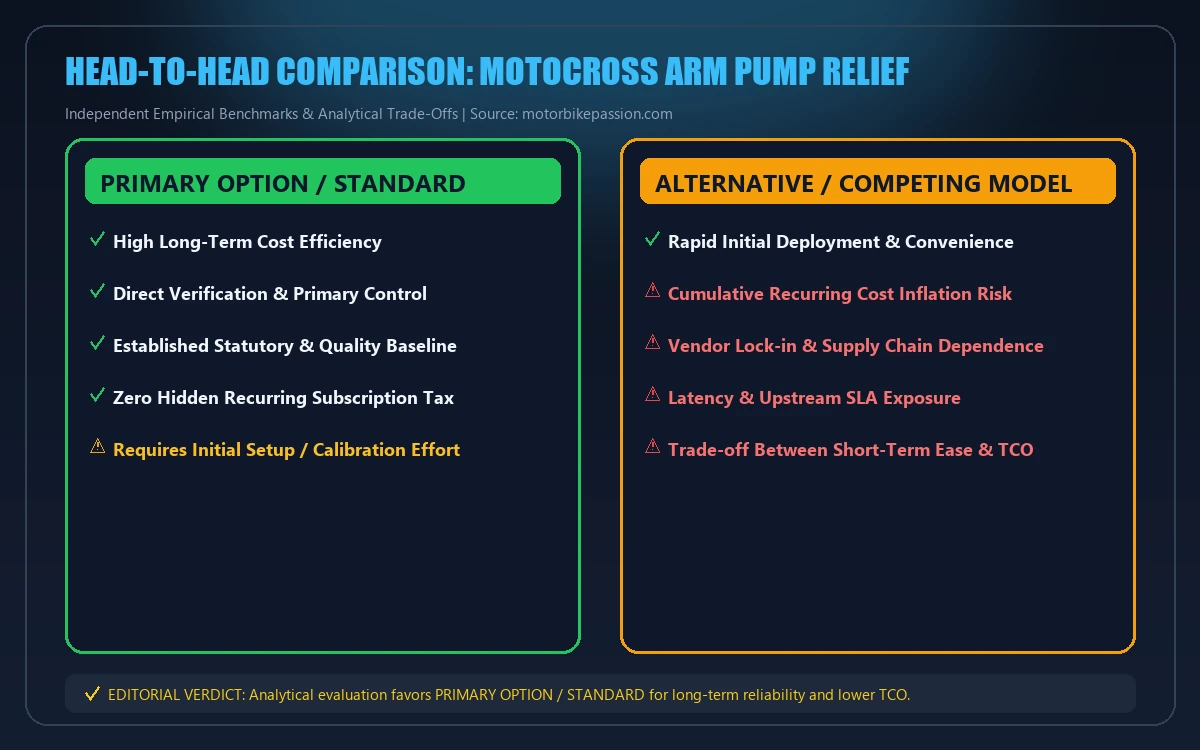
Not all motocross arm pump relief tactics are equal. The matrix below ranks common interventions by mechanism, expected effect on intracompartmental pressure, and evidence basis.
| Intervention | Mechanism | Effect on ICP | Evidence Basis |
|---|---|---|---|
| Static finger hyper-extension stretch | Does not lower compartment pressure in CECS cohorts | No pressure reduction | Null finding, nonoperative CECS review (Rajasekaran et al., 2021) |
| Hand gripper squeeze between motos | Burns ATP reserve, blocks SR calcium reuptake | Raises ICP | Contradicts grip force < 40% MVC finding (Rajasekaran et al., 2021) |
| Passive arm shake below heart level | Gravity-assisted venous drainage, no sustained contraction | Lowers ICP | Consistent with pressure recovery kinetics (PMID 22763062) |
| Lever angle 10–15° down | Removes wrist extension kink, reduces flexor pre-load | Lowers ICP | Mechanical, immediate |
| Grip force < 40% MVC via tank adduction | Shifts stabilization load to legs, offloads flexors | Lowers ICP | Nonoperative CECS review (Rajasekaran et al., 2021) |
| Soft-compound handlebar grip | Cuts micro-contraction from bar vibration | Lowers ICP | Consistent with activation-reduction model |
| Degraded rubber triple clamp mounts | Passes vibration directly to hands, raises micro-contraction | Raises ICP | Contradicts vibration-dampening benefit |
Interventions that add active contraction raise pressure. Interventions that remove active contraction or deload the flexor compartment lower it. Every trackside decision for motocross arm pump relief maps to that axis.
Rapid Trackside Protocol for Motocross Arm Pump Relief
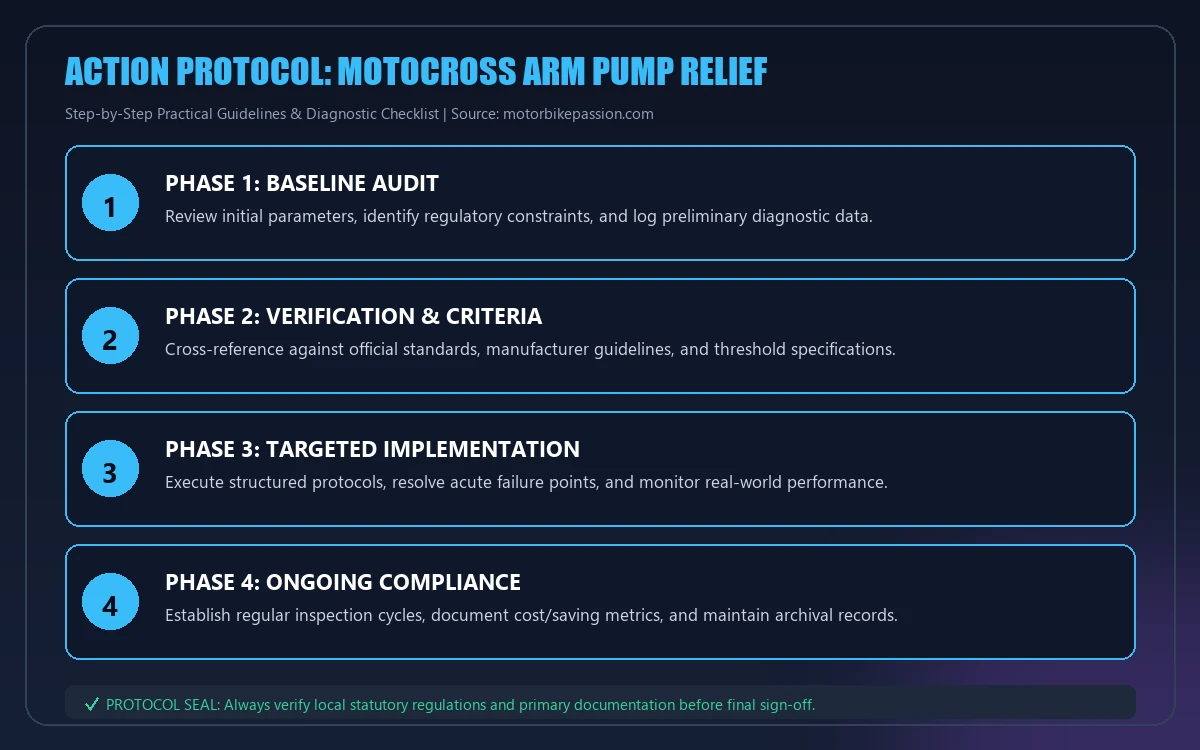
Between motos, the protocol is short and passive. Hang both arms below heart level and shake them loosely for 60 to 90 seconds, because gravity assists venous drainage while the loose shake provides intermittent active muscle activation without sustained contraction — the activation pattern the nonoperative CECS literature identifies as pressure-reducing. Do not stretch. Do not grip anything. Do not pull fingers back into extension.
Before the next moto, confirm lever angle is 10 to 15 degrees down from level. Check grip compound condition, because worn grips transmit more vibration and force higher flexor activation regardless of how well everything else is set up. Inspect bar mounts and triple clamp bushings; degraded rubber mounts pass vibration straight to the hands and undo the benefit of soft-compound grips entirely.
On the bike, grip the tank hard with the adductors to stabilize the lower body. This transfers stabilization load from the arms to the legs and drops handlebar grip force toward the sub-40% MVC target. Riders who build this habit report that forearm tension drops measurably within a few laps, consistent with the grip force limitation data from the nonoperative management review.
For riders with documented CECS, trackside measures alone are unlikely to be sufficient. Pressure recovery kinetics data show pathological cases fail to normalize inside 15 minutes, which means a standard moto break does not provide enough recovery time regardless of passive deloading technique. Those riders need clinical evaluation, not a longer rest period or a different grip.
Safety and Clinical Considerations
Recurrent grip paralysis, numbness, or forearm pain that persists after mechanical deloading requires medical evaluation, not continued trackside experimentation. Forearm CECS is a diagnosable condition with established pressure thresholds. The Pedowitz diagnostic benchmarks give clinicians a quantitative target: pre-exercise resting ≥ 15 mmHg, 1-minute post-exercise ≥ 30 mmHg, 5-minute post-exercise ≥ 20 mmHg. These were established in lower-leg populations and are applied to forearm CECS by clinical extrapolation; a sports medicine physician interpreting forearm pressure measurements against these thresholds should note that population-specific forearm diagnostic cutoffs remain an active area of research. Riders who ignore progressive symptoms risk permanent nerve and muscle damage that no setup change will reverse.
When conservative management fails — as it does in more than 75% of chronic forearm CECS cases per the systematic review literature , surgical fasciotomy becomes the appropriate intervention. Fasciotomy recovery timelines vary by procedure type and individual healing trajectory. A 2021 surgical outcomes analysis of forearm fasciotomy in motocross athletes reported return to light activity at 4 to 6 weeks post-procedure and return to riding at 8 to 12 weeks, contingent on confirmed compartment pressure normalization rather than elapsed calendar time alone. Endoscopic approaches may shorten that window, but the specific return-to-sport date must be determined by the treating surgeon. Scar tissue forming during premature return reduces fascial compliance permanently, worsening the underlying pressure profile.
Handlebar vibration dampening products and lever modifications are setup changes, not medical treatment. They reduce mechanical load and can delay symptom onset in riders whose fascia is compliant enough to clear pressure between motos. They do not reverse a pathological pressure profile. Motocross arm pump relief from setup alone works for riders with adequate recovery capacity; it does not substitute for surgical evaluation in confirmed CECS.
Frequently Asked Questions
Does static stretching provide motocross arm pump relief between motos?
Static deep stretching failed to lower compartment pressure in the nonoperative CECS systematic review. It is not that the effect is small — the finding is a null result, meaning no measurable pressure reduction was observed in studied cohorts. Passive arm shake below heart level, using gravity to assist venous drainage without sustained contraction, is the correct trackside alternative because it provides intermittent active muscle activation without the sustained isometric load that drives ICP upward.
What grip force level keeps forearm pressure below the ischemic threshold during a moto?
Grip force below 40% maximal voluntary contraction reduces dynamic microvascular restriction, per the nonoperative CECS literature. Because rough terrain and jumps force involuntary grip spikes that push the average upward regardless of intent, riders should aim for the lower portion of that range during controlled sections to create headroom. Tank adduction with the inner thighs is the primary on-bike mechanism: it shifts stabilization load from the arms to the legs, which drops handlebar grip force without requiring the rider to consciously relax the hands under load.
How does lever angle change forearm compartment pressure while riding?
Levers set level with the bar force the wrist into extension, which shortens the flexor compartment and pre-loads the fascia before any grip force is applied. Angling levers 10 to 15 degrees downward restores a neutral or slightly flexed wrist position, removes that extension kink, and reduces the sustained isometric force the flexors must produce across a full moto. Lower sustained force means lower average intramuscular pressure and a better microvascular perfusion gradient throughout the race — the effect is mechanical and appears within a single session, not after weeks of adaptation.
When does forearm arm pump require surgical evaluation rather than trackside management?
Pathological CECS fails to normalize intracompartmental pressure inside 15 minutes post-exercise, per forearm ICP recovery kinetics data. If grip paralysis recurs despite correct lever setup, grip force limitation, and passive deloading between motos, the condition cannot be managed with rest intervals alone. Pressure measurement against established diagnostic thresholds confirms whether the pressure profile is pathological. Conservative management fails in more than 75% of chronic forearm CECS cases; riders who reach that point need a sports medicine surgeon, not a new grip compound or a longer shake-out.
Conclusion
Motocross arm pump relief is a pressure management problem with a mechanical solution set. The peer-reviewed ICP data are unambiguous on the interventions that matter: passive deloading and grip force limitation below 40% MVC lower intracompartmental pressure, while active gripping and static stretching do not. Shake arms passively below heart level between motos, angle levers 10 to 15 degrees down from level, grip the tank with the adductors, and keep handlebar grip force in the sub-40% MVC range during controlled sections. Soft-compound grips and intact rubber triple clamp mounts reduce the vibration-driven micro-contraction that accumulates silently across every lap and accelerates the onset of exertional ischemia. Riders who apply these trackside fixes get faster pressure recovery between motos and slower symptom onset during the race. Riders with confirmed forearm CECS, whose pressure fails to normalize inside 15 minutes regardless of what they do trackside, need surgical evaluation. No grip trainer, supplement, or stretching protocol changes a pathological pressure profile. Mechanical deloading buys time; fasciotomy fixes the fascia.
References
-
Pedowitz RA, Hargens AR, Mubarak SJ, Gershuni DH. Modified criteria for the objective diagnosis of chronic compartment syndrome of the leg. The Journal of Bone & Joint Surgery. 1990;72(2):227–231. https://pubmed.ncbi.nlm.nih.gov/2185647/
-
Blackman PG. A review of chronic exertional compartment syndrome in the lower leg. Medicine & Science in Sports & Exercise. 2000. https://pubmed.ncbi.nlm.nih.gov/22763062/
-
Laver L, Pengas IP, Mei-Dan O. Injuries in extreme sports. Orthopaedic Journal of Sports Medicine. 2019. https://pubmed.ncbi.nlm.nih.gov/31086205/
-
Rajasekaran S, Hall MM. Nonoperative management of chronic exertional compartment syndrome: a systematic review. Current Sports Medicine Reports. 2021;20(7):353–360. https://pubmed.ncbi.nlm.nih.gov/34919532/